Diastolic Augmentation
Sequential cuff inflation raises diastolic aortic pressure and supports coronary perfusion during the phase when coronary flow is greatest.

Enhanced External Counterpulsation (EECP) uses ECG-gated, distal-to-proximal sequential pneumatic compression of the calves, thighs and hips to augment diastolic pressure and reduce cardiac workload.
During diastole, the cuffs inflate sequentially from distal to proximal, increasing venous return and augmenting diastolic aortic pressure. This enhances coronary perfusion pressure at the point in the cardiac cycle when coronary blood flow is greatest.
Immediately before systole, the cuffs rapidly deflate, reducing peripheral vascular resistance and left ventricular afterload. The combined haemodynamic effect is increased diastolic augmentation with relative systolic unloading.
EECP is delivered using three sets of pneumatic cuffs applied to the calves, thighs and hips.
The cuffs are synchronised to the patient's ECG and inflate in sequence during diastole, from distal to proximal. They then deflate rapidly and simultaneously immediately before systole.
Treatment timing is adjusted during each session using ECG and finger plethysmography to optimise the treatment waveform.
Cuff pressures are gradually increased according to patient tolerance, with therapeutic pressures commonly targeted in the range of approximately 250–300 mmHg.
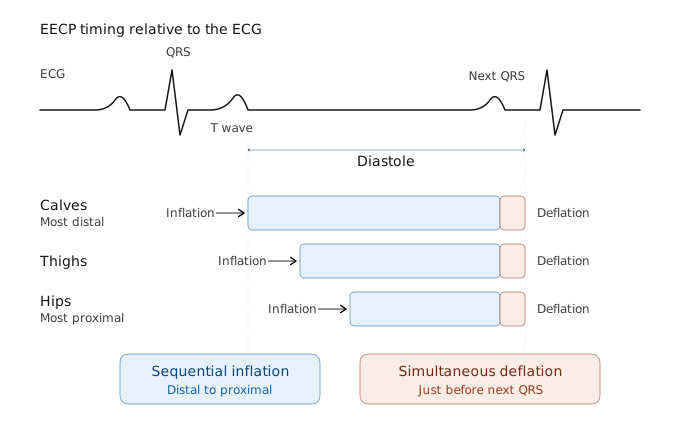
Sequential cuff inflation raises diastolic aortic pressure and supports coronary perfusion during the phase when coronary flow is greatest.
Distal-to-proximal compression displaces blood centrally, increasing venous return to the right heart.
Rapid pre-systolic deflation lowers peripheral vascular resistance and reduces impedance to left ventricular ejection.
Together, enhanced diastolic perfusion and reduced systolic workload may improve myocardial oxygen supply–demand balance.
Sequential cuff inflation during diastole raises diastolic aortic pressure, frequently increasing it above the patient's native systolic pressure. Because the coronary arteries fill predominantly during diastole, this augmented pressure is mechanistically positioned to improve coronary perfusion pressure at exactly the point in the cardiac cycle when coronary blood flow is greatest. In patients with significant coronary stenosis, this enhanced diastolic pressure gradient may also help drive blood through collateral channels toward ischaemic myocardium. The magnitude of augmentation is one of the key parameters monitored during each treatment session using finger plethysmography.
The distal-to-proximal compression sequence — calves first, then thighs, then hips — progressively milks venous blood centrally toward the heart. This increases venous return and right-sided preload, contributing to an increase in cardiac output during treatment. Unlike pharmacological afterload reduction, this effect is mechanical and occurs in time with each cardiac cycle. Over a full course of EECP, the repeated central volume displacement is also one of the proposed stimuli for the longer-term vascular adaptations observed in some studies.
Immediately before the next systole, all three cuff sets deflate rapidly and simultaneously. This produces a sudden fall in peripheral vascular resistance, so that when the left ventricle ejects, it does so against reduced impedance. The result is a decrease in cardiac workload and myocardial oxygen demand during the contraction phase. This pre-systolic unloading is the mirror image of the diastolic augmentation effect, and correct deflation timing relative to the ECG is essential to achieve it without impairing the augmentation phase.
Diastolic augmentation acts to increase myocardial oxygen supply, while pre-systolic afterload reduction acts to decrease myocardial oxygen demand. EECP therefore addresses both sides of the supply–demand equation within a single cardiac cycle. This dual action is the central physiological rationale for EECP as an anti-ischaemic therapy and distinguishes it from most pharmacological anti-anginal agents, which typically act on demand alone. In refractory angina populations, where conventional demand-reducing options are often already maximised or limited by tolerance, this supply-side contribution is the principal proposed benefit.
Repeated EECP treatment may produce vascular effects beyond acute diastolic augmentation.
Published studies have reported improvements in peripheral endothelial function, including flow-mediated dilation, nitric oxide-related markers, endothelin activity and shear-stress signalling.
These findings provide mechanistic support for EECP's vascular effects, but should be interpreted alongside the broader clinical evidence base rather than as independent treatment endpoints.
EECP and intra-aortic balloon pump therapy both apply the principle of counterpulsation, aiming to augment diastolic pressure and reduce systolic afterload.
The clinical context is very different. EECP is non-invasive and delivered through external pneumatic cuffs in an outpatient setting. IABP is invasive, catheter-based and used for temporary haemodynamic support in acute inpatient or critical care settings.
| Feature | EECP | IABP |
|---|---|---|
| Invasiveness | Non-invasive external cuffs | Invasive intra-aortic catheter |
| Setting | Outpatient | Inpatient / critical care |
| Treatment course | Repeated one-hour sessions | Continuous short-term support |
| Patient group | Selected stable patients with chronic ischaemic symptoms | Acutely unstable patients requiring haemodynamic support |
| Clinical role | Adjunctive therapy for symptoms and functional limitation | Temporary circulatory support |
Together, these mechanisms — diastolic augmentation, increased venous return, reduced afterload and possible vascular effects — provide the physiological rationale for EECP's role in patients with chronic ischaemic symptoms.
Major EECP trials, registry data and guideline recognition.